
Raptor Science & Conservation Series (RSCS)
2026–2027 Syllabus
Course Description
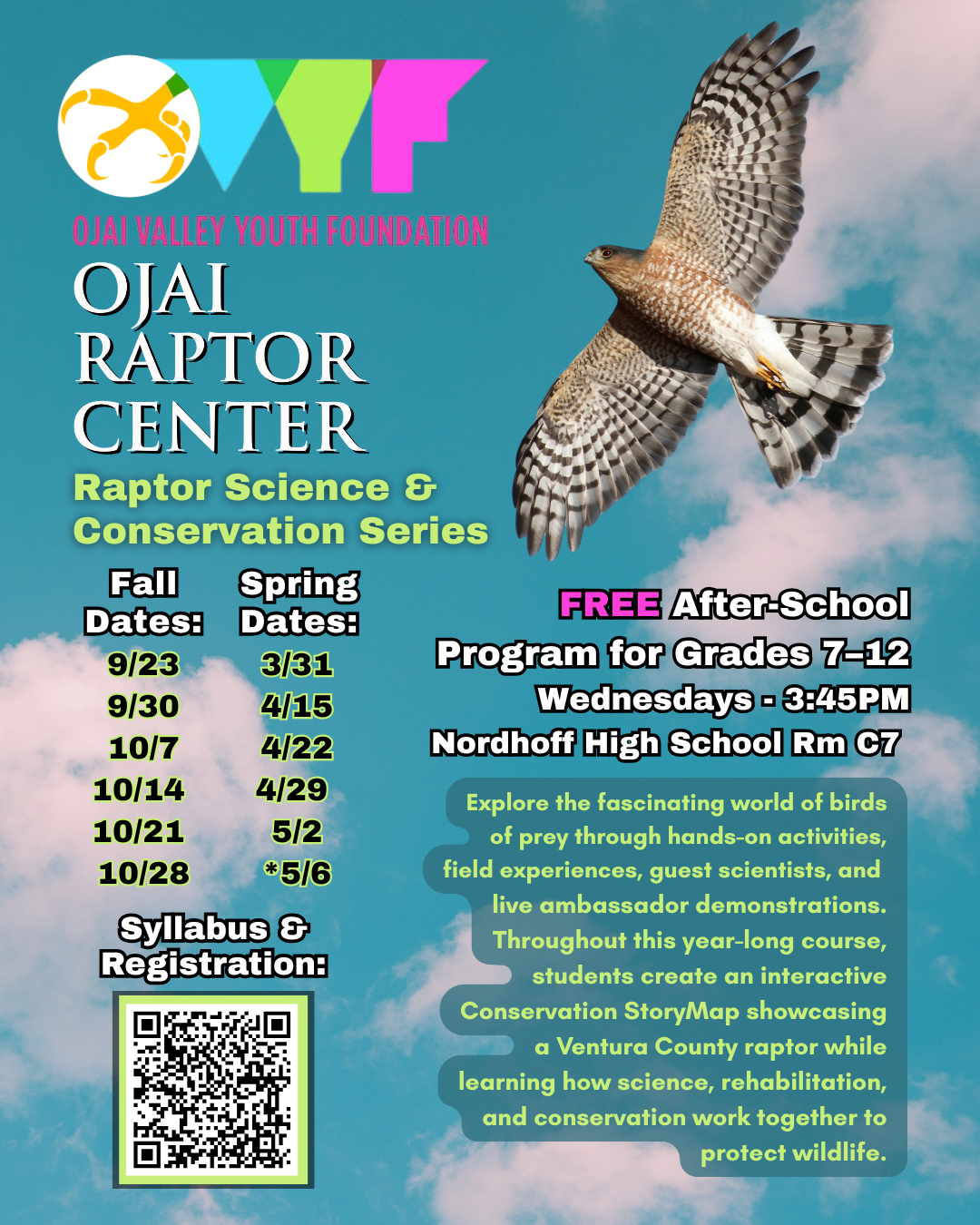
The Raptor Science & Conservation Series (RSCS) is a year-long program for middle and high school students exploring the biology, ecology, rehabilitation, and conservation of birds of prey. Through hands-on activities, field experiences, guest scientists, rehabilitation case studies, and live ambassador demonstrations, students will investigate the remarkable adaptations of raptors while exploring the conservation challenges they face.
As a capstone project, students will create the RSCS Conservation StoryMap Project: Raptors of Ventura County—an interactive digital field guide that combines scientific research, mapping, and storytelling to communicate the ecology and conservation of a Ventura County raptor species.
Fall Semester
Wednesdays | September 23 – October 28
September 23
Course Introduction: Raptors, Rehabilitation & Scientific Inquiry
Students will be introduced to the Ojai Raptor Center, wildlife rehabilitation, and the ecological importance of raptors. Through discussion and interactive activities, they'll explore how scientists investigate wildlife and how conservation decisions are made. Students will also be introduced to the year-long ArcGIS StoryMap project and select a Ventura County raptor species to study throughout the course.
StoryMap Milestone: Create project, choose species, gather reliable scientific sources.
September 30
Introduction to Raptor Taxonomy: Families, Form & Function
Students will explore the remarkable diversity of raptors through hands-on examination of study skins, wings, feet, skulls, feathers, and taxidermy specimens. Together we'll investigate how anatomy reflects ecology while learning to identify the major raptor families found in Ventura County.
StoryMap Milestone: Species profile, taxonomy, identification, and physical adaptations.
October 7
All About Owls: Specialized Predators of the Night
This session explores the unique evolutionary history, sensory adaptations, hunting strategies, and identification of owls through biofacts, multimedia, and vocalizations. Students will compare owl adaptations with those of other local raptors to better understand how different species occupy unique ecological niches.
StoryMap Milestone: Behavioral and anatomical adaptations.
October 14
Raptor Migration & Field Ecology
Field Trip to Ojai Meadows Preserve with Biologist Angel Ramirez
Students will develop bird identification and field observation skills while exploring raptor habitat at Ojai Meadows Preserve. Through guided birdwatching and discussion, students will investigate migration, habitat selection, food webs, and the ecological importance of Ventura County for both resident and migratory birds of prey.
StoryMap Milestone:Habitat, range, migration or residency, and field observations.
October 21
Bird Banding & Conservation Research
Guest Instructor: Rainey Barton, Biologist
Students will learn how scientists study wild bird populations through bird banding, telemetry, satellite tracking, and long-term monitoring. The class will examine how these research tools help answer questions about migration, survival, and population health while informing conservation decisions.
StoryMap Milestone: Population trends, current research, and conservation status.
October 28
Conservation Challenges Facing California Raptors
Through real patient case studies from the Ojai Raptor Center, students will investigate the greatest threats facing California's birds of prey, including rodenticide poisoning, habitat loss, window collisions, lead toxicity, electrocution, wildfire, and climate change. Rather than simply identifying these threats, students will examine practical conservation solutions—from integrated pest management and habitat restoration to public education and responsible human behavior—and discuss how each of us can help protect raptor populations.
StoryMap Milestone: Conservation challenges, rehabilitation case studies, and actions that support healthy raptor populations.
Spring Syllabus
Wednesdays | March 31 – April 28
March 31
Returning to Raptors: Wildlife Rehabilitation Case Studies
Students will reconnect after the winter break by analyzing real patient cases from ORC's wildlife hospital. Through diagnostics, radiographs, treatment plans, and rehabilitation outcomes, students will explore how wildlife rehabilitators make complex decisions while reviewing key ecological concepts introduced during the fall semester.
StoryMap Milestone: Rehabilitation challenges affecting their species.
April 7
Scientific Illustration: Observation as a Scientific Tool
Students will strengthen their observation skills through scientific drawing using ORC's biofact collection. By carefully illustrating feathers, feet, skulls, wings, and other specimens, students will discover how close observation reveals the relationship between anatomy, adaptation, and ecological function.
StoryMap Milestone:Original illustrations and anatomical observations.
April 14
Wildlife Rehabilitation Techniques
Students will gain hands-on experience with several techniques used by licensed wildlife rehabilitators, including wing wrapping, feather imping, patient assessment, and rehabilitation planning. Real patient case studies will illustrate how science, veterinary medicine, and husbandry come together to return injured raptors to the wild.
StoryMap Milestone:Common injuries and rehabilitation methods.
April 21
Animal Behavior & Empowerment-Based Training
Students will explore the science of animal learning and behavior through the lens of modern empowerment-based training. Interactive activities and demonstrations will illustrate how positive reinforcement, choice, and behavioral science improve animal welfare while supporting veterinary care, rehabilitation, and ambassador education.
StoryMap Milestone: Natural behaviors, behavioral adaptations, and ambassador education.
April 28
Falconry, Flight Conditioning & Modern Rehabilitation
Guest Instructor: Lord Forde, Master Falconer
Students will explore the ancient art of falconry and its relationship to modern wildlife rehabilitation and conservation. Through a live falconry demonstration, they'll learn how falconry techniques help rehabilitators assess flight ability, build fitness, and prepare injured raptors for release. The class will also examine how falconers have contributed to raptor conservation, including the recovery of species such as the Peregrine Falcon.
StoryMap Milestone: Add conservation history, rehabilitation techniques, or behavioral observations relevant to their species.
*Saturday May 8
Field Experience at the Ojai Raptor Center
Students will visit the Ojai Raptor Center for an immersive behind-the-scenes educational experience. They'll tour the rehabilitation facilities, meet ORC's education ambassador raptors, observe natural behaviors in the training aviary, and connect the concepts they've studied throughout the year to real-world wildlife conservation.
The course will conclude with students sharing highlights from their completed StoryMaps and reflecting on how science, rehabilitation, education, and community action all work together to conserve California's birds of prey.